Research press page: charts, citation and summary
Everything a writer needs to use the DTC Health Trustpilot Report 2026: five charts, the citation line, a two-sentence summary and an address. All of it is free to use with a link to the report.
100% risk-free. You only pay for the reviews that come down.
The report in two sentences
Remove One Star read the public Trustpilot profiles of 127 US health brands on September 19, 2026. Across the four online health categories, 404,135 reviews sat on 64 profiles, an estimated 8.6% of them 1-star, and the median 1-star share was 11% on claimed profiles against 69% on unclaimed ones.
Citation line
Remove One Star. (2026). DTC Health Trustpilot Report 2026: 1-star reviews and TrustScores across 127 health brands. Data collected September 19, 2026. https://www.removeonestar.com/research/dtc-health-trustpilot-report-2026
Please give the collection date, September 19, 2026, with any figure. The methodology and the limitations are on the report, and the aggregate table is a CSV download.
Questions and corrections
Write to team@removeonestar.com. We answer questions about the method and the figures. We do not name the brands in the sample, and we publish no client names or removal counts. General company facts and the wordmark are on the press and brand page.
The five charts
Data collected September 19, 2026. Press Embed to copy an image tag that points at the PNG on this site and links back to the report.
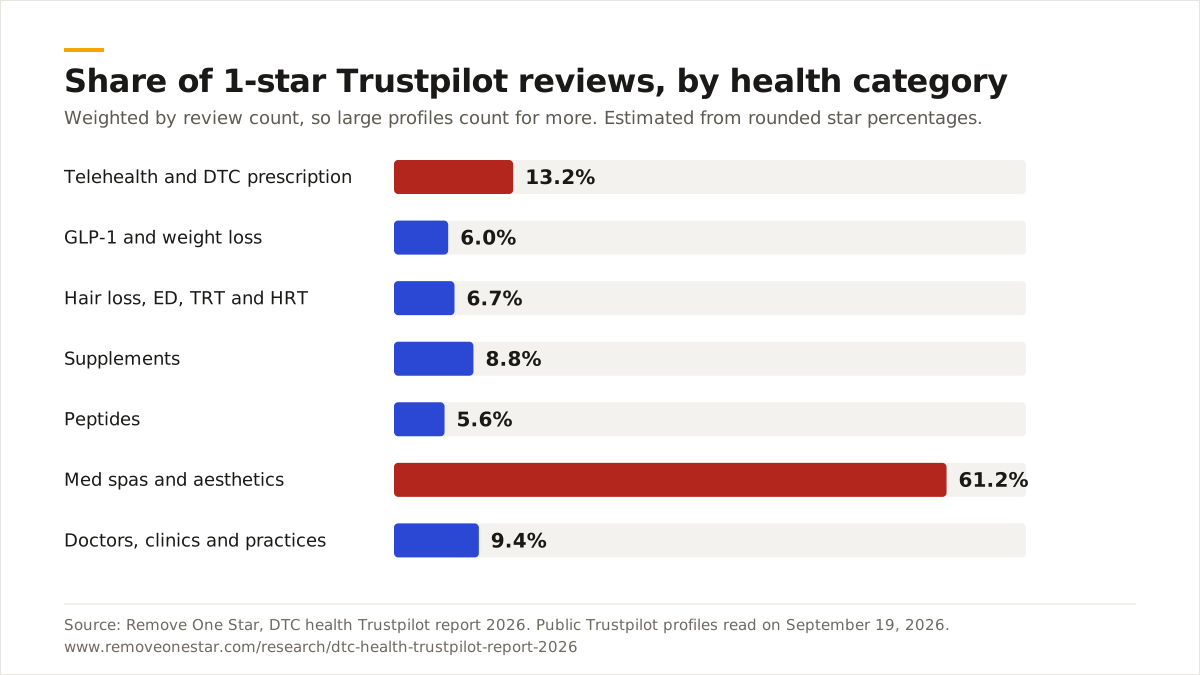
Share of 1-star Trustpilot reviews, by health category
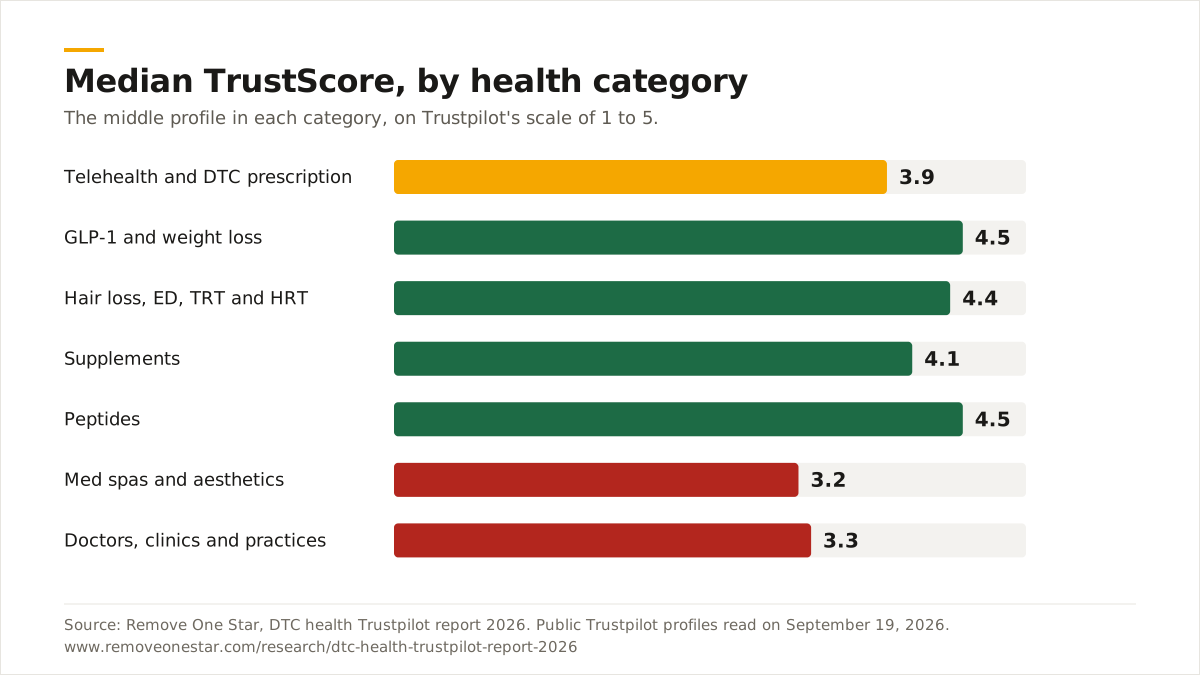
Median TrustScore, by health category
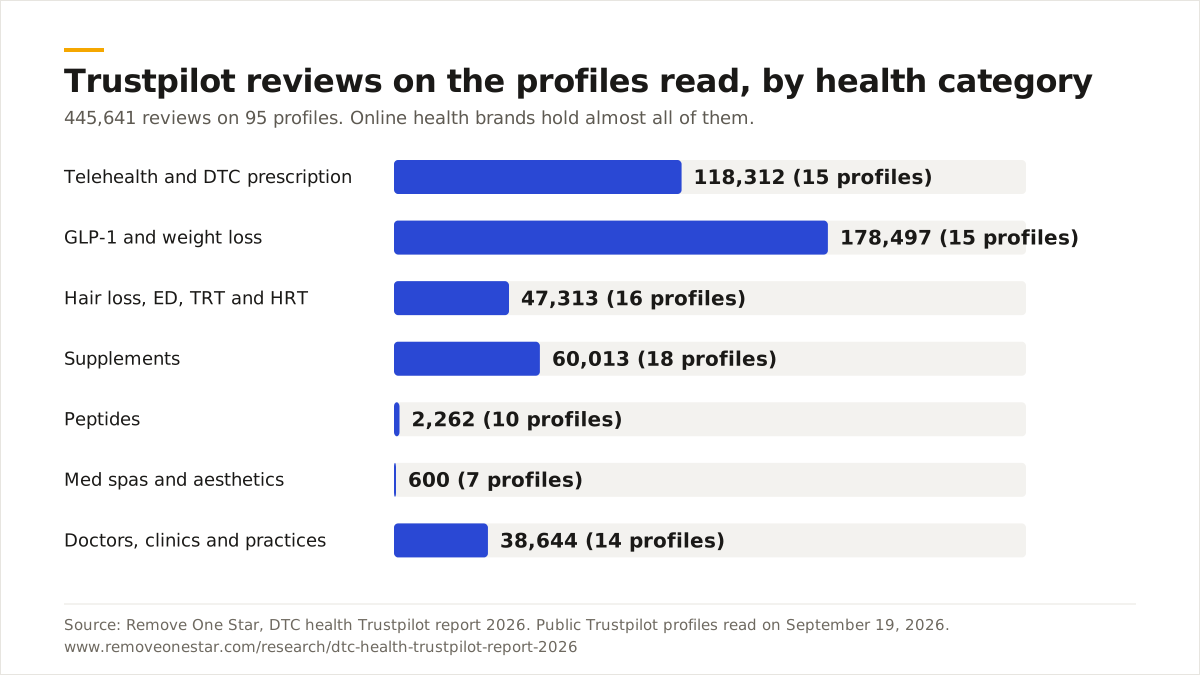
Trustpilot reviews on the profiles read, by health category
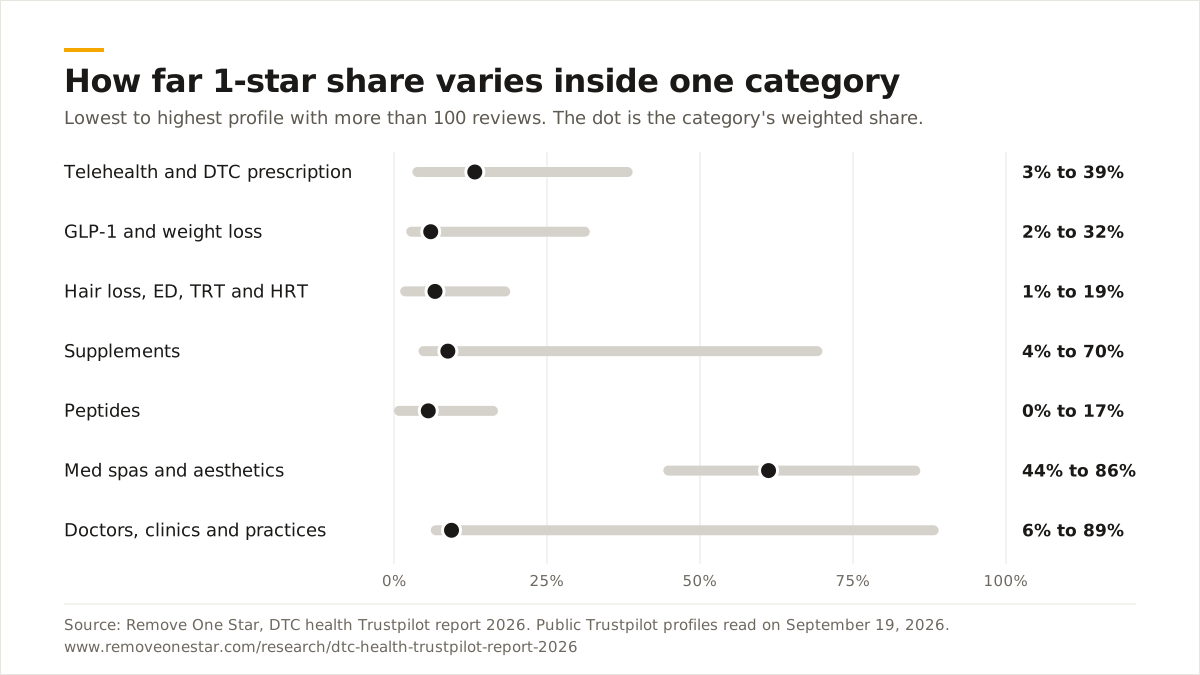
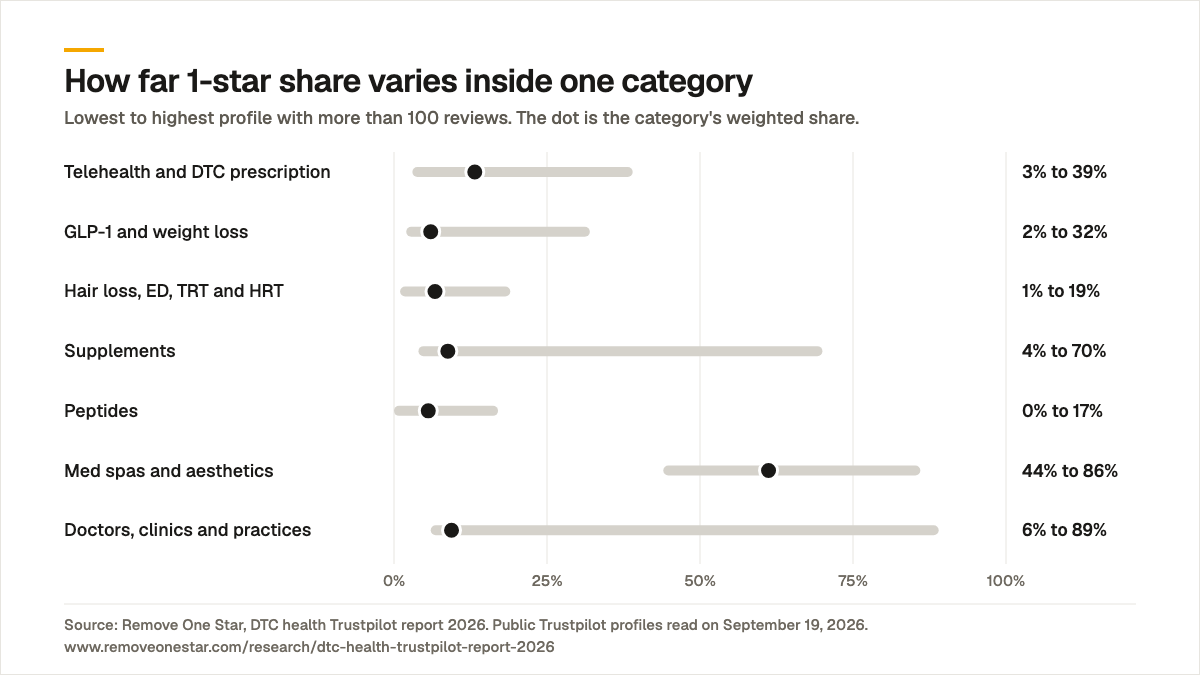
How far 1-star share varies inside one category
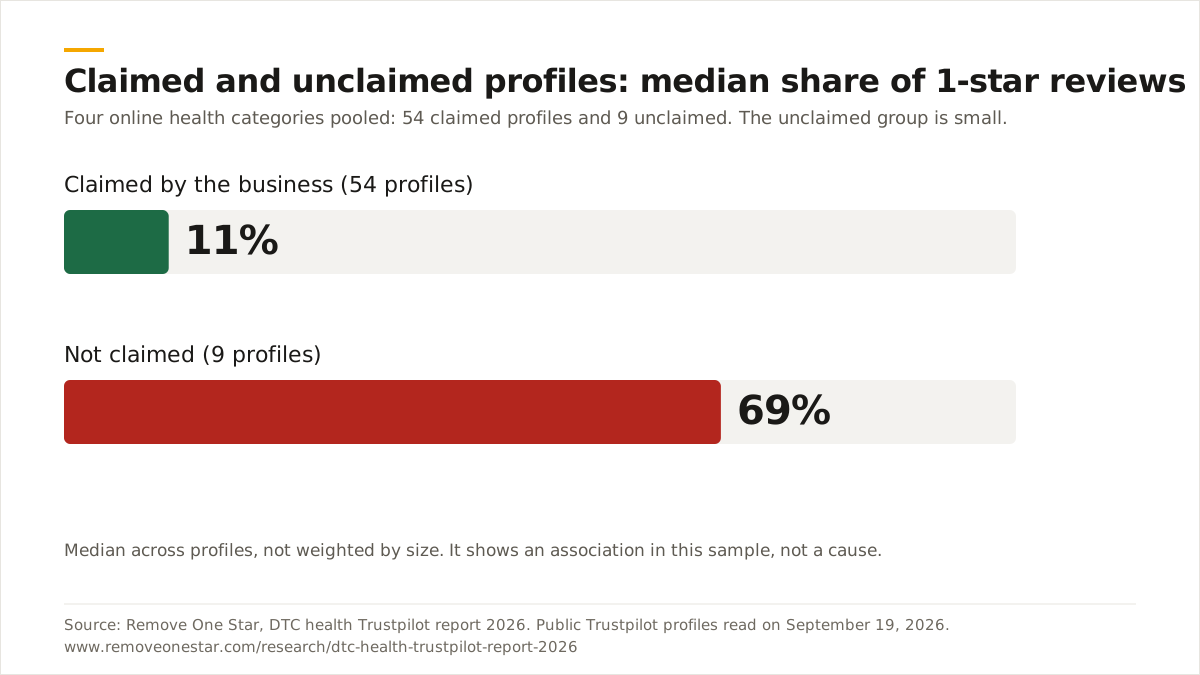
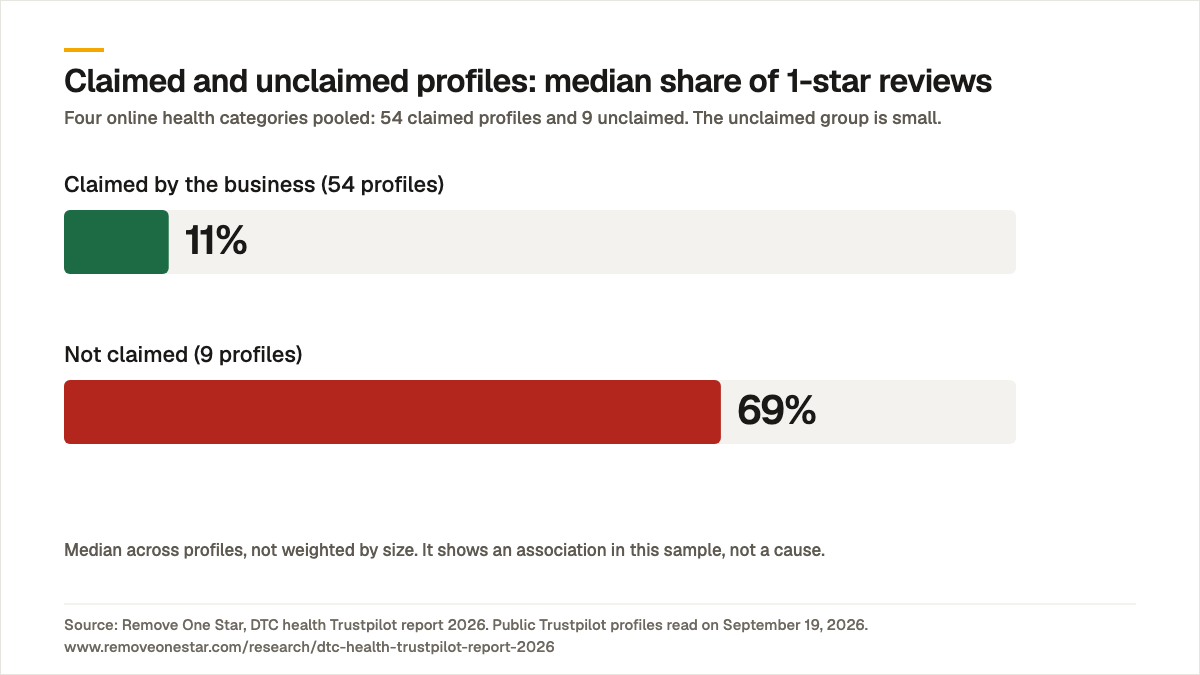
Claimed and unclaimed profiles: median share of 1-star reviews
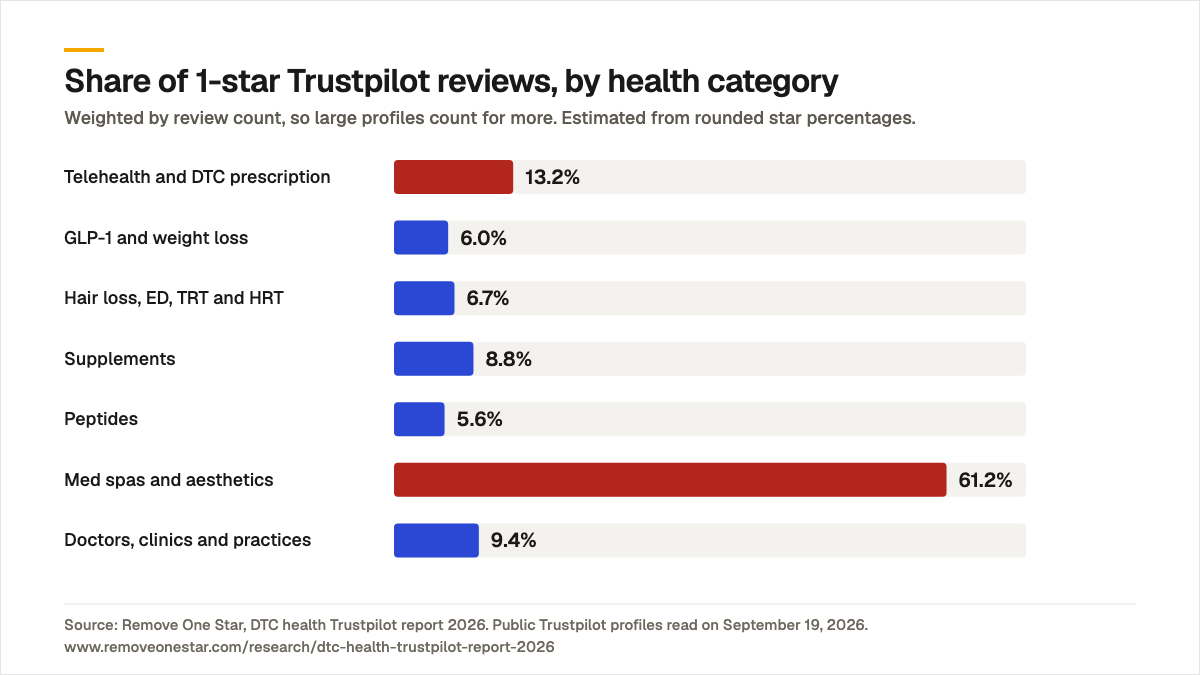
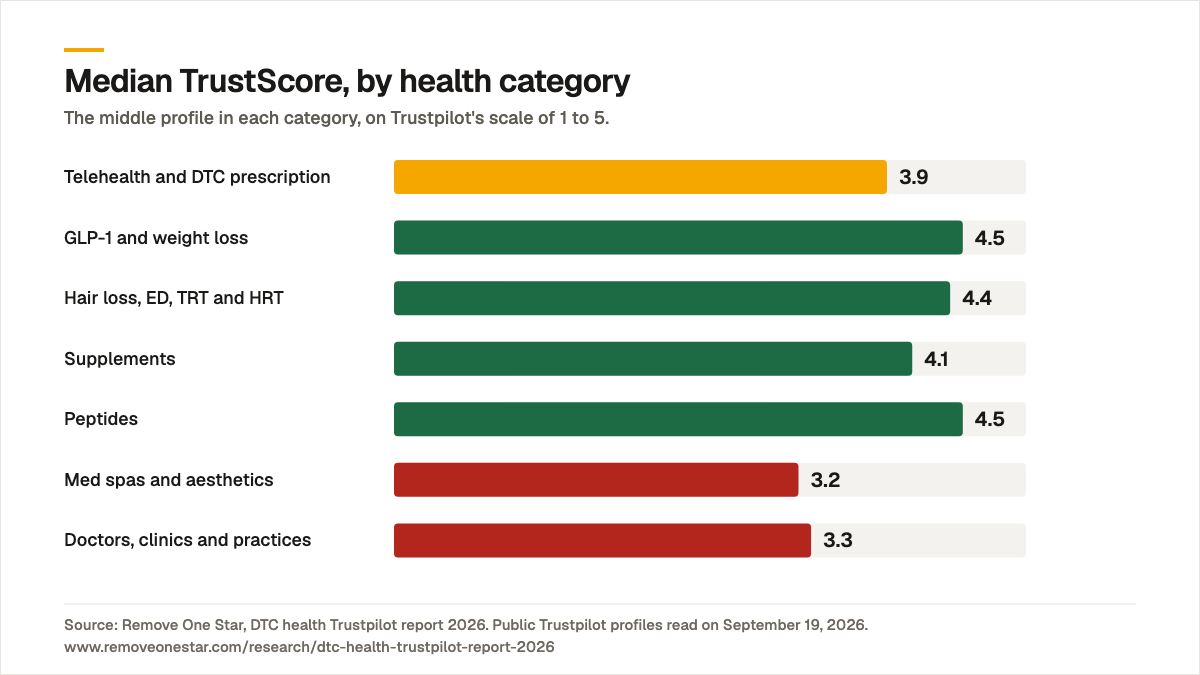
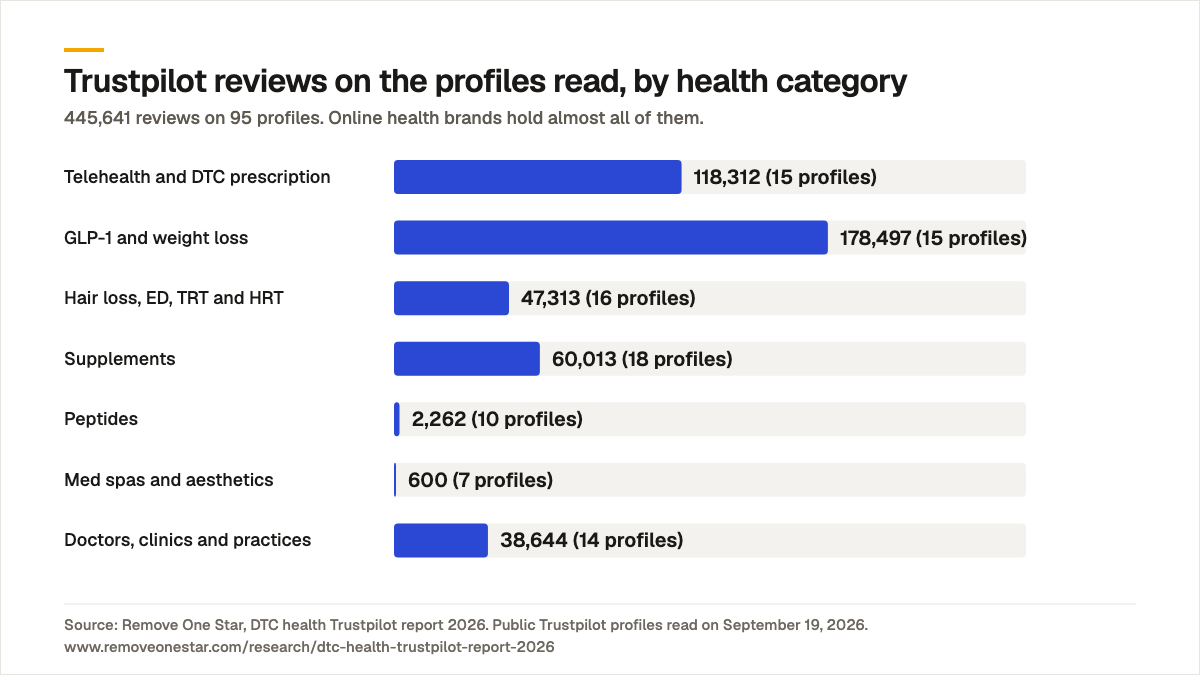
A short page for journalists, newsletter writers and other sites that want to use the DTC Health Trustpilot Report 2026. It lists the report's five charts, each with downloads as SVG and PNG and an embed code. It gives the suggested citation, a two-sentence summary of the findings, and the address for questions and corrections, team@removeonestar.com.
The report itself has the full table, the methodology, the limitations and a CSV of the aggregate data. Every figure was collected from public Trustpilot profiles on September 19, 2026. No brand is named.
What is in the report?
The report is a dated reading of public Trustpilot profiles. We looked up 127 US health brands across seven categories on September 19, 2026, and 95 of them had a Trustpilot profile with reviews on it. Everything we read is visible to any visitor.
From each profile we took the review count, the TrustScore, the star breakdown Trustpilot prints, whether the profile was claimed, and whether it carried Trustpilot's notice about not inviting customers. The report then adds those up by category and publishes the totals.
Four of the seven categories are online health brands: telehealth and DTC prescription, GLP-1 and weight loss, hair loss, ED, TRT and HRT, and supplements. Together they held 404,135 reviews on 64 profiles. An estimated 34,575 of those reviews, or 8.6%, were 1-star.
Telehealth had the highest 1-star share at 13.2% and the lowest median TrustScore at 3.9. GLP-1 had the lowest 1-star share at 6.0%, on the largest volume of reviews. The full table in the report gives brands checked, profiles with reviews, total reviews, median TrustScore and 1-star share for all seven categories, and it downloads as a CSV.
The report also carries the spread inside a category, the split between claimed and unclaimed profiles, and its own limitations. Those sections are worth reading before quoting a figure.
What does each chart show?
There are five charts. Each one is on this page as an SVG, downloads as SVG or PNG, and has an embed code that links back to the report.
The first is "Share of 1-star Trustpilot reviews, by health category". It is weighted by review count, so large profiles count for more, and the shares are estimated from the rounded star percentages Trustpilot prints.
The second is "Median TrustScore, by health category". It shows the middle profile in each category on Trustpilot's scale of 1 to 5, not an average of scores.
The third is "Trustpilot reviews on the profiles read, by health category". It covers 445,641 reviews on 95 profiles, and it shows that online health brands hold almost all of them.
The fourth is "How far 1-star share varies inside one category". It runs from the lowest to the highest profile with more than 100 reviews, and the dot marks the category's weighted share. It is the chart to use if you want to show that a category average hides a wide spread.
The fifth is "Claimed and unclaimed profiles: median share of 1-star reviews". It pools the four online health categories, 54 claimed profiles against 9 unclaimed ones. The unclaimed group is small, and the chart says so.
How should I cite it?
Use the citation line printed on this page. It names Remove One Star as the author, gives the report title and the year, states the collection date, and ends with the report's address. Copy it as it stands.
The charts and the figures are free to use, in a story, a newsletter, a deck or a post. The one condition is a link back to the report from the page that uses them. A plain link to the report page is enough, and the embed code adds it for you. If the format has no links at all, name the report and the collection date in the text instead.
Please carry the collection date with any figure you quote. The data is a single day, and a profile can change the day after. A number without its date stops being checkable, which is the part that matters to us.
Is there anything else I can quote?
Yes. The review statistics we publish collect thirty figures about reviews from Trustpilot, Google, Yelp, two named buyer studies and the FTC. Each one carries the period it describes, the primary page it came from, the date we last read that page, and a caveat where a reader could overstate it.
Nothing on it is ours. It is a working list of other people's published numbers, with the ones we could not trace left out and listed as dropped. The whole table downloads as a CSV.
How was the data collected?
From public Trustpilot profiles, on one day: September 19, 2026. Nothing behind a login was used.
The sample was chosen by hand. For each category we listed well-known United States brands that appear in search results and AI assistant answers for that category, then opened each brand's public Trustpilot profile. A brand that belongs to two categories is counted once.
The 1-star shares are estimates, and the report is plain about why. Trustpilot shows star percentages rounded to whole numbers. We multiplied the 1-star percentage by each profile's review count and summed across the category. On a few profiles the star breakdown could not be read. Those profiles stay in the review totals and drop out of the share.
The median TrustScore is the middle value across profiles with reviews, so one very large brand does not set the figure.
No brand is named, in the report, in the charts or in the CSV. Everything is published as a category aggregate. The report's method and limitations sections carry the rest, including what the numbers cannot show.
What will you not say?
We answer questions about the method and the figures, and we stop there. Some things are not available at any price.
We do not name any brand in the dataset. Publishing one company's 1-star share next to its name would single it out for public data it already displays. It would also tell a reader nothing the category totals do not.
We name no clients, and we publish no removal counts, no success rates and no ratings of our own for any company. We do not rank the brands in the sample, and we do not tell you which of them are customers.
These are not ad hoc rules for this report. They come from our editorial policy, which sets out what we publish, how we correct it, and what we leave out.
Who do I contact?
Write to team@removeonestar.com. It is the address on the report and on this page.
We answer questions about the method, the definitions and any figure in the report. If you think something is wrong, send it and we will check it. Corrections are made in public, with a note saying what changed.
For company facts, the wordmark and general enquiries, the press and brand page is the right place. The report itself holds the full table, the method, the limitations and the CSV.